Mastering Fielding in Cricket: Insights from T Dilip
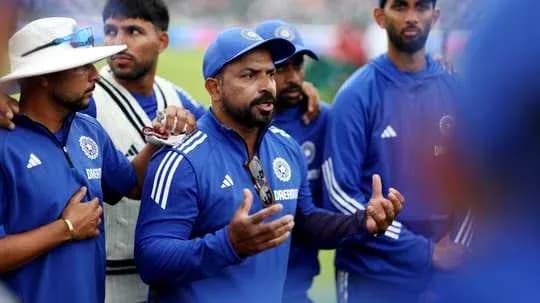
T Dilip has spent the last four years living in the part of cricket most fans only notice when it goes wrong. A dropped catch. A misfield. A throw to the wrong end. For India’s former fielding coach, those moments are not accidents. They are the final line in a long chain of decisions, movements and habits.
In a detailed conversation with Cricbuzz, he stripped fielding down to its moving parts – and then built it back up into something far more complex than a simple “good hands, good arm” cliché.
Catching: Different Skills, Same Ball
For Dilip, a catch begins long before the ball reaches the hands.
“With catching, we look at the player’s starting position, how early he picks up the ball, whether his head remains stable and how his hands move in relation to his body,” he explained. The checklist is precise. The demands change with the role.
A slip catch, a high outfield take, a flat chance inside the circle – they may all end with fingers wrapped around leather, but the skills are not remotely the same. Footwork, body shape, timing, even the way the eyes track the ball shift with each position.
Ground fielding, he says, starts before the bat makes contact. The best fielders anticipate, stay balanced, and make an efficient first movement. Simply reaching the ball is not the job. Arriving under control is.
“He should ideally arrive under enough control to complete a clean pick-up and prepare the throw.” That, in Dilip’s world, is non-negotiable.
Throwing, too, is not just about a rocket arm. Power is only one line in the equation. Speed of release, accuracy and decision-making weigh just as heavily. Who you are and where you stand shape the work you do.
“I would not give a slip fielder, an inner ring fielder and a boundary fielder the same programme,” he said. The fundamentals connect everyone, but the practice has to mirror the situations a player will actually face.
Multi-Sport Kids and the Chaos of the Ball
Ask Dilip about early development and he goes straight to movement, not drills.
Children who play multiple sports, he argues, learn to solve different movement problems. Fielding is inherently unpredictable. The ball never arrives the same way twice – not at the same height, speed or angle. Adaptability becomes a weapon.
That does not mean football or hockey alone will create an elite fielder. Cricket still demands its own vocabulary: reading the bat, judging trajectory, understanding surfaces, picking up cleanly, throwing accurately. But an athlete who has already learned to cope with chaos has a head start.
IPL: The Fielding Revolution
On one point, Dilip does not hesitate. The IPL has changed Indian fielding.
“Without any doubt, the IPL has had a positive influence on Indian fielding,” he said. “It has completely changed the importance given to that part of the game and the standards young Indian players are exposed to.”
A young domestic player can walk into an IPL dressing room and suddenly share a field with some of the world’s best fielders. He watches how they prepare. How they treat every ball as live. How they stay locked in even if they have not batted or bowled.
“That kind of exposure can accelerate a player’s development tremendously,” Dilip pointed out.
Recent numbers have shown some fluctuation in catching efficiency. Dilip accepts that this needs proper analysis. But he is clear: the IPL has not damaged Indian fielding. It has transformed it. It has raised expectations, widened the pool of capable fielders and drilled home a simple truth – fielding can swing a result as sharply as batting or bowling.
The Missing Numbers: Fielding’s Data Gap
Cricket can measure the degree of swing for a fast bowler, the revs on a spinner, the speed off the bat. Fielding, by comparison, still lives in the shadows.
“Fielding is more complex because position, distance, angle, surface, anticipation and decision-making are all involved in the same play,” Dilip said. At present, catches and run-outs tell only a fraction of the story.
He wants a different level of detail. Where was the fielder standing when the ball was struck? How quickly did he react? Was his route to the ball efficient? How fast did he move from pick-up to release? On throws, velocity and accuracy matter – but so does whether he chose the right end.
Even catching percentage, one of the few available metrics, can mislead. A more athletic fielder may reach a ball that most would never get near, get a fingertip to it, and be marked down for a drop. Another fielder might not even arrive, and the numbers stay clean.
“Ideally, every opportunity should be judged by its difficulty,” he said. Reaction time, distance covered, ball speed, direction of movement, proximity to the boundary – all of it should feed into the assessment. Those same factors tie directly to a player’s athletic ability.
The same logic applies to runs saved. If a fielder turns a likely two into a single, that small intervention should be visible. Across a tournament, those tiny margins pile up into something decisive.
Bowlers Turned Fielders
Ask a coach to pick one success story and most will reach for a star name. Dilip goes the other way.
“It is always difficult for me to say that a player improved ‘under me’ because the biggest credit must belong to the player,” he said. An international cricketer will work with his state side, his IPL franchise, national coaches – a fielding coach is only one stop on that journey.
Still, one shift pleased him more than most: the transformation of India’s bowling group as fielders.
What moved him was not just better technique. It was a change in mindset. Fast bowlers and spinners started taking genuine pride in saving a run, backing up a teammate, or holding a tough catch after a draining spell. They began to own the craft.
“So, rather than naming one player, I would give that appreciation to the entire bowling group,” he said. Watching them embrace fielding with that kind of energy and selflessness became one of the most rewarding parts of his tenure.
The Invisible Skill Before the Ball
At the highest level, Dilip does not believe any fielding skill is truly underestimated. International players arrive with awareness. They know the basics. But there is one area he keeps coming back to.
Preparation before the ball is struck.
It is not as glamorous as a diving stop or a leaping catch on the rope, so it rarely gets the same attention. Yet for him, it sits at the heart of elite fielding.
“Anticipation is not guesswork,” he said. It grows from game awareness, knowledge of angles, and staying involved before every delivery. A good first step can turn a difficult stop into a routine one. A poor first step can make a reachable ball look impossible.
He would not call it underrated. He calls it unfinished work – an area where players at every level, from juniors to international stars, can keep finding small gains.
T20, Workload and Lost Reps
It is easy to blame T20 cricket for everything that looks rushed or untidy in the modern game. Dilip refuses that shortcut.
He sees the shortest format as a catalyst that has dragged fielding standards up. Players are quicker across the turf. Boundary catching has become an art form of its own. Pick-up and release speeds have jumped.
The real challenge lies elsewhere: schedule.
With matches, travel and recovery stacked tightly together, players naturally pour more time into their primary skills – batting and bowling. In franchise cricket, fielding practice may be optional on certain days, tailored to individual workloads and recovery plans.
The risk is subtle but real. A player can lose the sheer volume and “feel” of catches that build confidence. “The first few catches in a match almost become his practice,” Dilip warned. That is not where anyone wants to be.
He does not believe the answer is marathon fielding sessions. The key is to ring-fence a small block of consistent, high-quality catching work, even on lighter days. Players must own that preparation – during tournaments, before them, and in the off-season.
“Ultimately, consistent catching comes from consistent effort,” he said. Simple, and unforgiving.
Touch, Confidence and the Coach’s Real Job
Even the best in the world need help finding their rhythm when a new series or tournament begins. Catching, Dilip insists, is about touch and confidence as much as technique.
The ball might carry differently at a new venue. Wind and lights can alter its path. A player may field in a new position or to a different type of bowler. A handful of focused repetitions can tune the hands and body to those conditions.
In those moments, the coach is not always there to fix a flaw. Sometimes the job is more subtle: to prepare a player for the specific demands of that tournament, to make sure his first real chance does not feel like his first practice.
In an era obsessed with bat speed and ball speed, Dilip’s message is blunt. Fielding is not a side note. It is a science, an attitude, and a habit – built one step, one catch, one throw at a time.