Pakistan's Test Collapse at Edgbaston: A Heavy Mood
The sky over Edgbaston sagged low and grey at lunch on day one of the third Test. Somehow, the mood in Pakistan’s dressing room felt heavier still.
This was supposed to be the reset. A flurry of bold, controversial changes from the Pakistan Cricket Board, billed as the jolt that would shock this side back to life. Instead, after just 23 overs, the tourists staggered to 100-7 and looked anything but revived. If you’re holding tickets for day three, you might already be wondering what else to do with your weekend.
A team unravelling
The scale of the collapse was brutal. Pakistan’s top five were all gone with only 48 on the Thwaite Memorial scoreboard, a procession that carried a slice of unwanted history with it.
It was only the 12th time in Test cricket that a team’s top five have all been dismissed for single figures. Never before had it happened in a first innings. That is the depth of the hole Pakistan dug for themselves before lunch in Birmingham.
Former captain Ramiz Raja did not sugar-coat what he was watching. He called Pakistan’s “technique and mindset” “pretty ordinary” on Test Match Special, and his assessment only grew harsher.
“There’s mental fatigue and turmoil in the dugout, I can understand that,” he said. “But from an individual point of view, I think Pakistan have been waiting for the ball to come and damage them completely. They have not been proactive at all. They have to have a plan. This is a flat pitch, it’s not a demon-like pitch, like the third day at Lord’s.”
That last point stung. Because for all the gloom, this was not a minefield.
England ruthless, Pakistan brittle
England’s seamers did their part. Under autumnal skies more suited to late September than a high summer Test, Joe Root won the toss, handed the ball to his four-pronged pace attack and watched them go to work.
They hit a nagging length, found enough movement, and never really let Pakistan breathe. Former England captain Michael Vaughan summed up the visitors’ state as “clearly shot for confidence” after a morning that lurched from bad to worse.
“I feel for Pakistan because this is embarrassing with everything they’ve had to cope with in the last week,” he said.
The numbers behind this series tell their own grim story. No team has ever begun innings in England as badly as Pakistan are doing now. Their second wicket has fallen with the score on 6 and 13 at Leeds, 16 and 7 at Lord’s, and now 14 at Edgbaston. That’s 56 runs in total for the first two wickets across the series, an average of 5.6 for the opening stand and 11.2 when the second wicket falls.
They are on course to undercut a record that has stood since 1888, when Australia averaged just 16 for the fall of their second wicket in a series in England. This is not the kind of history any batting unit wants to chase.
Sympathy and exasperation
There is room for sympathy amid the wreckage. Saim Ayub, thrust into this Test as an opener, is playing first-class cricket for the first time since October 2025. To go from that level of red-ball inactivity to facing Ollie Robinson under a heavy sky at Edgbaston is not a gentle reintroduction. His dismissal felt almost inevitable from the moment he marked his guard.
Yet Pakistan cannot hide behind rust and misfortune alone. Too many shots reeked of carelessness, of a side playing as if the term was already over. They needed discipline. They offered strokes that belonged in a highlights reel, not in a salvage operation.
At 40% in the morning session, Pakistan’s false-shot percentage was the second highest in the opening session of a Test since 2006. That is not bad luck. That is poor judgement.
Four down, with the innings already teetering, Saud Shakeel and Babar Azam went after width outside off stump, blades flashing extravagantly. Two players into their thirties, two men with ample experience, and two who should have been the calm in the storm. Instead, they fed it.
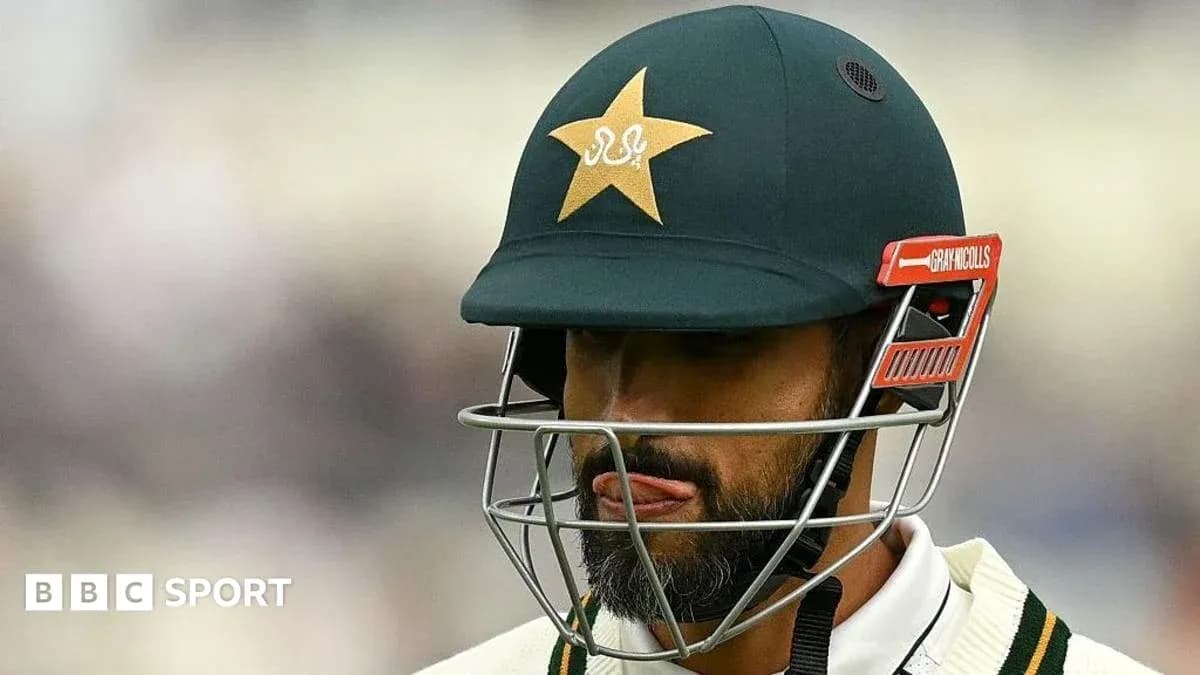
Saud clung on until lunch. Babar did not. About 40 minutes before the interval, he was bowled by Josh Tongue, then gestured towards the surface in frustration, as if the pitch had betrayed him.
Ramiz Raja saw something deeper in that dismissal.
“He [Babar] disintegrated. It’s tough for him,” Ramiz said. “He’s got to explain all this mayhem and then he has to look after himself and then he’s got to work with the lot that are more T20 in nature than Test cricket.”
A series slipping away
There was some mitigation in the numbers. CricViz’s bounce inconsistency rating had this pitch at 5.7 – higher than the surfaces used in 2025 against India (2.6), 2024 against West Indies (3.2) and 2023 against Australia (3.3). The ball misbehaved enough to keep batters honest.
But this was not a strip to justify 100-7. It was not a deck to excuse top-order chaos or a false-shot rate scraping historic levels. England were disciplined, relentless and smart. Pakistan were fragile.
“This innings is in serious turmoil,” Ramiz concluded.
The worry for Pakistan is that it’s not just the innings. It’s the series, the batting order, and, on the evidence of this morning, the very belief that they can last long enough in English conditions to fight back.