Carlos Alcaraz Survives Tough Start to Advance at US Open
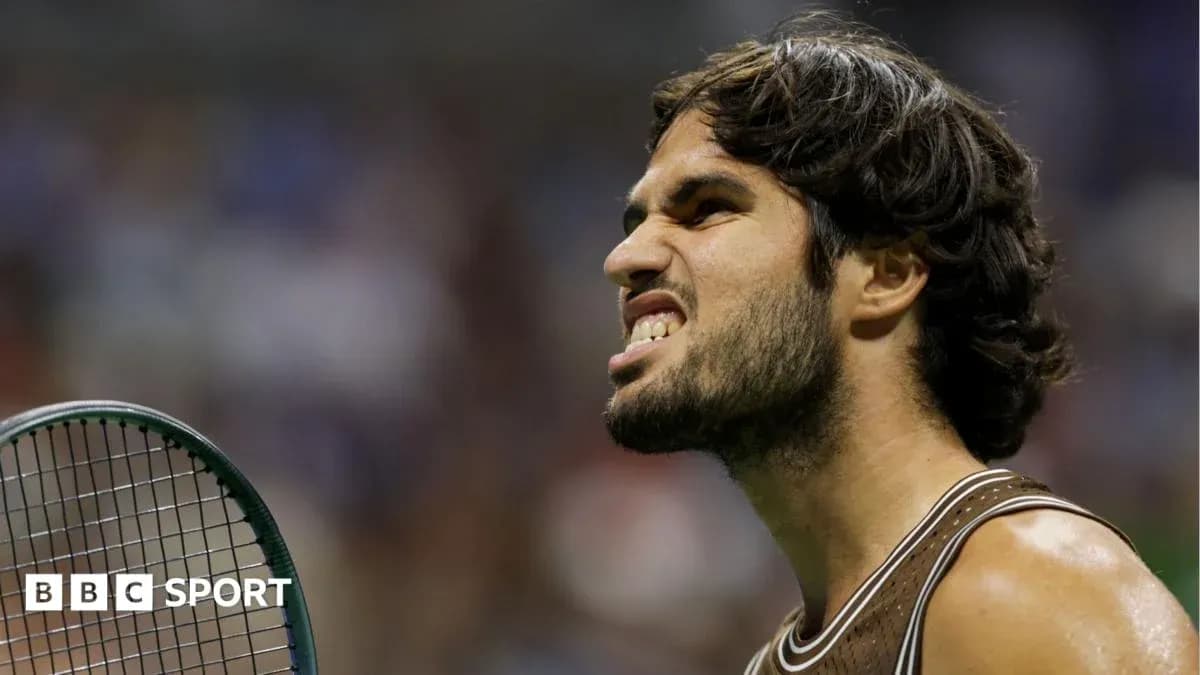
Carlos Alcaraz bends but does not break. Under the New York lights, the defending US Open champion flirted with trouble, then slammed the door shut.
The Spaniard, still feeling his way back from a long-term right wrist injury, dropped the opening set to Portugal’s Jaime Faria before roaring back to win 4-6 6-0 6-3 6-2 and reach the last 32.
For a set, it looked awkward. Rusty. Human.
Then the switch flicked.
A shaky start, a decisive moment
Alcaraz, 23, admitted he “felt great in the first set” but didn’t play with enough urgency. That hesitation cost him as world number 72 Faria settled faster, attacked early in rallies and punished short balls to snatch the opener.
The turning point came almost immediately in the second set.
Serving at 0-0, Alcaraz stared down two break points. Lose that game, and the Arthur Ashe crowd might have started to fidget. Instead, he dug in, saved both, and held. The pressure finally told on Faria, and from there the match flipped on its head.
Alcaraz tore through the second set 6-0, the kind of ruthless response that has defined his rise. The forehand, the shot everyone has been watching since that wrist injury in April, started to crackle again. He stepped inside the baseline, took the ball early, and stopped playing like a man afraid of the past few months.
“I know once I step on the court, I’ve just got to go for it every time. I’ve got to feel normal,” he said. “I have to hit like I was hitting before the injury. I’m feeling great. There is no reason to be afraid and not hitting normal.”
The words matched the body language. The doubt drained away.
Rhythm returns, questions remain
By the third set, Alcaraz was dictating almost every rally. He broke early, protected his serve, and forced Faria into riskier and riskier shots. The Portuguese player, 23 and still learning this stage, could not sustain the level that had rattled the champion in the first set.
The scoreline tightened — 6-3, then 6-2 — but the pattern did not. Alcaraz had taken control and never let it go.
This US Open is his first tournament since mid-April. The obvious question coming in: how would the wrist, and the rest of his body, cope with the grind of best-of-five sets after such a long lay-off?
He eased through his opener against Roman Safiullin in straight sets and said then that he felt “normal.” Against Faria, the test was different. He had to chase the match. He had to respond physically and emotionally after a poor start.
“At the end, I realised that playing four sets was really good for me to test everything physically, to test my body, how I feel, and how I’m going to feel tomorrow after this match,” he said.
This was not just about survival. It was a stress test passed.
A wide-open draw and an old swagger
The context around him is impossible to ignore. Jannik Sinner, his fiercest rival in this generation’s early chapters, is missing through injury. Novak Djokovic, the 24-time major champion, is already out. The draw, on paper, has cracked open.
Alcaraz, a two-time US Open champion, does not need an invitation. He can sense opportunity.
The field will stiffen from here. Higher-ranked opponents than Safiullin and Faria await, and the cumulative load of five-set matches after months away is still an unknown. But the second seed is moving with more confidence, hitting with less fear, and talking like a player who believes the worst of the injury saga is behind him.
Next up is China’s Wu Yibing, ranked 113th in the world, in the third round. Another chance to sharpen, another chance to see how the body responds to repeated efforts under the Ashe lights.
Americans advance, a seed falls
Elsewhere in the men’s draw, the American charge kept rolling.
Tommy Paul, the 20th seed and a possible fourth-round opponent for Alcaraz, posted a solid 6-2 6-3 5-7 6-4 win over Croatia’s Dino Prizmic. Paul will now meet 15th seed Alexander Bublik, who dismantled French veteran Adrian Mannarino 6-3 6-1 6-1 with his usual blend of power and flair.
Ben Shelton, seeded eighth and carrying the burden of hope to become the first American men’s champion at Flushing Meadows since Andy Roddick in 2003, survived a stern test from Hubert Hurkacz. Shelton edged the Pole 6-3 5-7 7-6 (7-3) 7-5, another step in a campaign that feels heavier with expectation every round.
Frances Tiafoe, twice a semi-finalist here and one of the crowd’s great favourites, delivered a clean, composed performance in a 6-3 7-6 (7-2) 7-5 victory over Japan’s Rei Sakamoto. His form looks sharp, his confidence obvious.
Not everyone escaped.
Spanish 12th seed Rafael Jodar suffered the most brutal exit of the day, crushed 6-2 6-1 6-1 by Chinese world number 124 Bu Yunchaokete. A straight-sets dismantling, a reminder that the chaos of the early rounds still has teeth.
As the draw thins and the noise grows, Alcaraz stands where he has so often stood in New York: in the spotlight, chasing history, swinging freely again. The wrist has held. The body has answered.
Now the question shifts to everyone else: with the path opening and the champion warming to his task, who is going to stop him?